Independence: Climbing Huaynapicchu


My ticket for Machu Picchu included a ticket to climb a lesser known, ableit in-plain-sight, land mark: Huaynapicchu. It's the mountain looming behind Machu Picchu in every postcard of the place that you've ever seen (I have a picture like I'm talking about on my post "See"). I was going to climb it to the peak, a la cima.

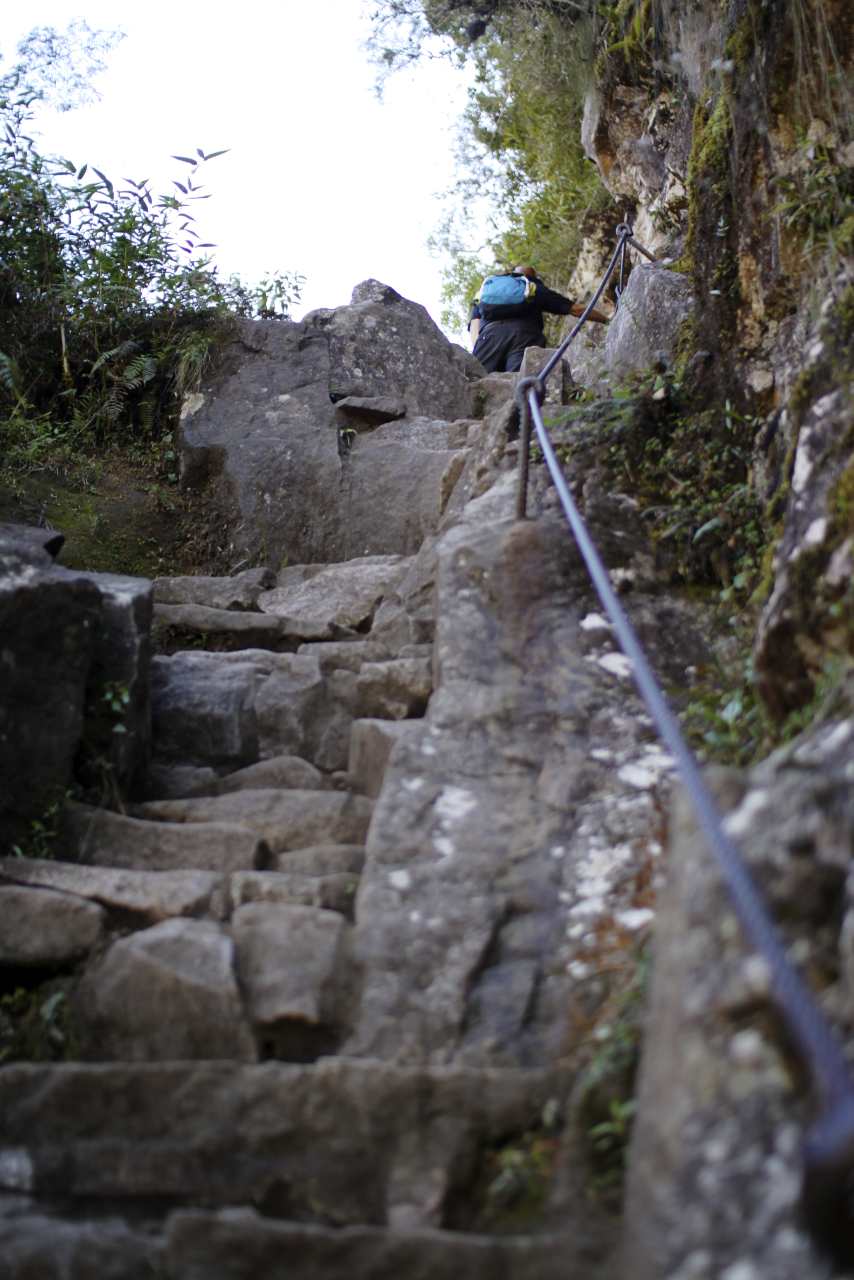
The path.
The steps—the climb—up to the top was made by the Incas. The steps are steep, but when they get really steep there's a rope (which was not made by the Incas). However, about two-thirds of the way up the trail takes a break from steps. Now the trail was just a steep, narrow trail of mountain. Here and there you'd get that rope, but more often than not you just relied on your balance and footing as you climbed ragged rocks up and up and up. You look over the edge, which is inches from you, and see just how high you are and just how easy it would be to make a mistake and fall off the mountain.

At this point it struck me: if something were to happen, there's no one to fall back on. There aren't park rangers or security guards on the mountain. If you were step wrong and shatter your ankle, there's no way you're getting down the mountain without using that same ankle. If you have a heart attack, there's no one to call for a helicopter—and if there were it would be impossible for the helicopter to pick you up from the mountain side. If you trip and fall, you could actually plummet from the side of the mountain.

Huaynapicchu.
We were all tourists climbing this mountain, but we were each entirely alone, entirely responsible for ourselves, entirely independent. It was not entirely familiar for me. My dependence was wrenched from me because Huaynapicchu rendered it impossible to hold onto. It was empowering. More so than at any other time in my life, I felt a powerful sense of being alone; alone in the sense of being a lone one: a lone person, independent of all others. Not a sense of irresponsibility of my effect on others, but a sense of total responsibility for my effect on myself.

At the top of Huaynapicchu I looked around and saw everyone else who had hiked to the peak as well, all on our own, each one of us. I've never felt or been quite as accountable for my actions as at that moment. Going back down the mountain the feeling stayed with me. The deep, clear breathes of independence at the peak of Huaynapicchu were very unfamiliar but very welcome.

Machu Picchu... is really a mystery

This is really what Machu Picchu looks like. I took that picture. That's crazy, and it's crazier to be there. The place is so much bigger than you expect—pictures don't really do it justice. It's also supposed to be an energy vortex, a place where a considerable amount of positive energy emanates from the earth. I can believe that. It was a very peaceful, take-a-deep-breath kind of place.

Anyway, our guide led us into Machu Picchu and showed us a good view, a better view, and a best view of the ruins (the above picture is from the best view). We were happy that our guide rushed us pretty quickly past good and better, because by the time we got to the best view most of the other tourists—it was kind of sad to be a tourist again—were stuck at the previous two spots.

Actual Machu Picchu.
Along the walk to the best view Cosme, our guide (who has written books about Machu Picchu), told us about some of the interesting history of the ruins. Probably the most interesting tidbit is that we know very little history. When it was found in 1911 the natives who showed it to Hiram Bingham had only come across it 7 years earlier, in 1904—and they were only that far up in the mountains because they were avoiding taxes. They didn't know what it was, when it was made, or what the city was for. In fact we don't even know it's real name; Machu Picchu is actually the mountain in the picture to the left. Everything we know about Machu Picchu has come from archeology and good guesses.

What we've got so far is that the city was a place where the elite lived as well as couples who were planning to get married. For the couples, the city was a testing ground. In Incan culture you had to live together for one year before you could get married—Machu Picchu was one such place that you'd live together because obviously a potential-married couple isn't going to go out and find their own plot of land just to test their relationship. After the year, if you made it, you would actually be given a plot of land and other Incans would come and build you a house on it. As for the elite, they were what you'd think: political and religious leaders as well as very skilled people.

We also know that the city would have been brightly colored in red and yellow because archeologists have found evidence of paint near the walls and buildings of the city. It would have been an even crazier-awesome place at its height, which coincidentally was only 500 years ago. Because Machu Picchu is only 500 years old!

Machu Picchu... is Up

After hiking up to Machu Picchu.
After walking through what seemed plenty like a real-life Disney World, we arrived at a bridge which looked like something out of Jurassic Park. No dinosaurs though, only men asking to see your ticket and passport. This is when I'd usually realize that I forgot my ticket, except on this occasion I had checked maybe 20 times to make sure I had that ticket over the past 2 days. I pulled out the ticket, the passport, and then walked across the bridge.

By this time it was about 5:15 or so and there was very little light. Everything looked blue and black. Thank goodness I had my headlamp—and I'm serious about that; it's a really good headlamp and I really needed it.

We began our ascent. And it was, to my knowledge at the time, quite an ascent. There's a reason that the actual road up to Machu Picchu is home to so many switch-backs—it's a steep climb up. We had steps on our climb, but not the steps you're used to. It's stone steps, ragged stone steps, all the way up. The altitude isn't quite as bad at Machu Picchu, but it still gets to you a bit. And I'm not going to pretend like I didn't get winded.

So after about 25 minutes of climbing I was wishing we were at the top, and about this time the sun was coming up as well. I got through it and at about 35 minutes in the sun was really making its way into the picture. No rays yet, but I didn't need my headlamp anymore.

I took this picture at about 35 minutes in as well. I tried a few tricks but without a tripod I couldn't really capture how sweet the coming sunrise was. Everything was purple and blue as the sun started climbing behind those mountains and it was pretty awe-inspiring to be at the same level as the tops of other mountains.

Just 15 more minutes and we arrived up at the top of our climb by about 6:05 am. The hike up is supposed to take an hour and a half. We did it in an hour. Boom.

After catching our breath and admiring the view we'd achieved through our own labors we waited just a few minutes until our guide, Cosme, arrived. He took us to the line (the back of the line) that leads to the actual gates into Machu Picchu.

See

Didn't I tell you I'd be taking a picture like this. I couldn't believe that this is the real view you get when you visit Machu Picchu. It was incredible. I'll be putting together a video of everything I saw because the scope of that place is just enormous. Pictures don't do it justice at all.

Pre Machu Picchu

Machu Picchu, in case you didn't know.
Tomorrow I'll be taking a picture almost exactly like that one at Machu Picchu. I'm all packed and ready to leave Cusco at about 4:00pm today. After a bus then a train I'll arrive in Aguas Calientes (the city at the foot of Machu Picchu) by about 9:30pm. Then its time to meet with our guide and then catch some sleep. Morning will come real soon because we're climbing up to Machu Picchu—on the road in the picture below—at 5:00 in the morning on Saturday and then spending the day there with some Projects Abroad friends and a great guide (or so we've heard).
Road up to Machu Picchu.

Lake Titicaca: LOST Style (part 2)

The Island... of Amantani.
Departing from Uros, we set out to find the island Charles Widmore style. It was a 3 hour boat ride to get to Amantani. There were awesome people in our tour, and most of the 3 hours was spent talking to them. An uncle and nephew from Idaho, 2 Australians, 2 French couples, a German, and a girl from the US who's working for an NGO in Lima. Topics of conversation ranged from "Money Ball" to the process of learning languages. It was a good boat ride.

The boat docked at the island… of Amantani at about 1:30 pm. From there we were all given a host family for the night. A French couple (might as well have been Rousseau of LOST and Inspector Clouseau from the Pink Panther), Brandon, and I got a family that seemed to live on the top of the island. Lake Titicaca sits at 12,000 feet above sea level. That's about 2 miles closer to the moon than any part of North Dakota. At the family's house in the clouds we were served fantastic soup, potatoes, cheese, and tea. The soup was a potatoey-vegetabley-spice deal that was very filling. Then came potatoes (of a variety that is only grown on this island), cheese, bread, and coca tea. So good.
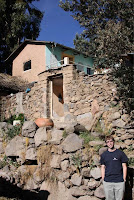
Our host house.
During lunch, my friend the Tourism General (Benjamin Linus) of Amantani paid a visit. He smiled too much and was super fishy. He told us, in Spanish, that "Your tour guide doesn't want to pay the full 30 soles per person for the host family and rather he's only paying 25." He went on to imply that if the guide only paid the 25, he would need us to pay 30 so the family would get their money for hosting us. That math didn't add up. 30-25=5, so if that story were true, we'd only need to pay an extra 5 soles, not 30. We never had to pay the 30 extra soles so it seems the tourism dude was just trying to squeeze more money out of us. Either way it's not a lot of money, but we had been assured by the tour company that everything was paid for. It's really tiring when it seems everyone is trying to scam you.

After lunch we met back up with the tour group and started a trek up to Pachatata at about 4:30, which is a temple to father earth. It's at the top of the island. Lake Titicaca is the second highest plateau in the world and the Pachatata temple is the highest point on the lake at 13,350 feet. It's hard to explain how tiring it is to walk up-and-up-and-up at that elevation. You're hardly doing any work at all, but you're out of breath the whole time.
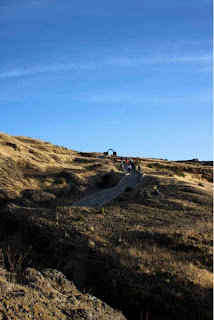
The long walk up the mountain.
The walk is incredibly exhausting and it just seemed to keep going and going and going. It was the Energizer Bunny of walks up island mountains.
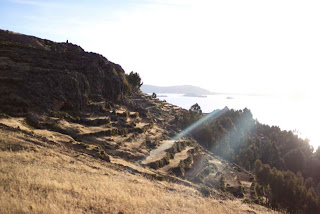
View of the mountainside.
We arrived at the top just before 6:00. Right as the sun was setting. We didn't get to go in the temple but that was alright. Someone must have captured the smoke monster in there.
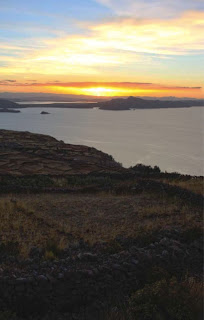
Sunset from Pachatata.
Supper was similar to lunch and just as great. We had a tea similar to coca, but mintier. It's called muña. Similar to coca it helps to treat headaches and stomach aches. Afterward we spent a long time checking out the stars and talking to Rousseau and Clouseau. They were very impressed by all the stars, because they can't see them through the light pollution in France. Even though we're in the deep deep south, you can still see the big dipper. The little dipper, however, is just below the horizon.

← Previous Page

Blogs I Read

Powered by Blogger.