Going to Africa


God is good and I'm being sent on another adventure because of that fact. I was chosen to be one of the four people invited to go to the Central African Republic (CAR) this April. 

Yes, that's in Africa. 

I'm visiting as a member of Western North Dakota synod of the ELCA. The Evangelical Lutheran Church of the Central African Republic (EELRCA) is a sister synod of ours — they've sent people to ELCA events in the U.S. and we're now reciprocating by visiting them. We have a lot to learn from each-other.

I'll be attending a Lutheran youth conference, learning about the CAR and the EELRCA, and traveling to other sites that the ELCA has been involved with over the years. One place I'm especially excited to see is the clinic that will be getting internet (for the first time) thanks to donations from Sunne Lutheran Church of Wilton.

The CAR is one of the poorest countries in the world. On the Human Development Index it ranks 179th out of 182 countries. It'll be pretty eye-openning to see what that means for the people whose home is the CAR.

There are 2 primary languages: French and Sango. I've looked, but found very-very little about Sango (except what's on Wikipedia). I'll keep looking for more — the language is structured in a pretty sweet way.

Thanks for your support as I prep for this adventure.

My grandparents were right

Just before leaving for Peru my grandparents asked if I had packed peanut butter. They told me that I'd want some as a taste of home down in Peru. I thought, Oh I've never been homesick so that won't be a problem. Nevertheless, peanut butter sounded like a good idea so I planned on getting to the store before leaving Bismarck to go pick some up. In the rush of finishing packing, I forgot to make that trip.

Flying somewhere over the U.S. I remembered that I forgot to make that trip. It would have been nice, but I'll be fine, I thought. And for a while I was fine.

A short while though. About a week after arriving I came down with giardia, and at that point there was nothing I wanted more than a taste of home. It was peanut butter that I was craving, and the craving never stopped. One day, in fact, I payed over $2.00 just for a Reese's (which are a rare animal here). They simply don't eat peanut butter down here in Peru. It's nowhere to be found.

But I kept looking, and just a few days ago I found some peanut butter. A month and a half of looking in every shop for peanut butter and now I have some. It cost 19.00 soles which comes to around $8.00 but it was worth it, because my grandparents were right. When you're traveling for an extended period of time it's really nice to have a taste of home.

Venture to Machu Picchu's Foot

PeruRail to Aguas Calientes.
Arriving at Machu Picchu was it's own adventure. First you have to take a bus from Cusco to a city called Ollantaytambo, which is about an hour and a half. Next you have to take a train to Aguas Calientes, which is the city right at the foot of Machu Picchu. You can actually only get there by walking or by train--there are no roads that lead to Aguas Calientes. The train only takes about 2 hours from Ollantaytambo.

Our trip was pretty interesting. First the bus to take us to Ollantaytambo was late by more than an hour, which was further complicated by the parade that blocked the road. There's always a saint being carried somewhere.
Some saint parade.
It was a big deal that the bus was late. Our train was going to leave Ollantaytambo at 7:00 pm and we were still a city away from that destination at 6:35. I asked another passenger how long to Ollantaytambo and they said (in Spanish) "Close to 25 minutes." Great... That really rose my blood pressure and added to how anxious I already was. If we would have missed that train we would have had to buy a whole new ticket--and who knows if there were even any more trains that night.

But we made it. We stepped on the train with about 10 minutes to spare before the train left the station. Pretty lucky.

The train was an interesting time as well. People just breast feed wherever they want down here, and of course one such mother and her crying baby sat right across from Brandon and I. To our left was a girl whose laugh had a knack for driving you crazy and her friend who was making her laugh the whole trip. But, the train had coffee and that really helped the situation a lot.
At the end of this trip, we arrived in the gloriously warm and humid Aguas Calientes at about 9:00 pm. There was a man from our hotel holding a sign reading "MAX" and he led us to our hotel. We stayed at a place called Margarita's House, and I'd recommend it. It was a little taste of home. The beds were so comfortable and the toilet had a toilet seat.
Toilet seats are pretty rare down here for some reason.

Lake Titicaca: LOST Style (part 1)


This last weekend Brandon and I went to Lake Titicaca and took a 2 day tour around three islands: Uros, Amantani, and Taquile. The total tour only cost S/. 75, which comes to about $30. It included all transportation, 3 meals, and lodging. Sick deals, sick deals.

As I tell about the trip, I hope you’ve seen LOST.

We took a bus from Cusco to Puno late Friday night. The bus didn’t crash on the island, but the way our driver careened about it was like crashing for 8 hours straight. Eventually we arrived at about 6:30 in the morning, just as the sun was coming up. A very sales-womanly lady pushed a tour on us (the one I’ve previously mentioned) and it sounded like a good deal so we took it.

After getting picked up from the bus terminal another bus took us to our boat--NOT PENNY’S BOAT. There were about 15 other people on the same tour. Immediately upon sitting down a wandering pan-flutist forced his music on us, and promptly insisted we pay him. In the US we have street performers and sometimes you toss a dollar in their hat if you appreciate what they’ve got going on. Here in Peru they practice a more proactive version. They corner you, then treat you like an ATM. I only had change so that’s all I gave the guy. Also he pan-fluted some Simon and Garfunkle.

And we’re off! The first stop was the floating islands of Uros. They float and you can move the island whenever you need to. You don’t even have to turn the wheel; just lift the anchors.

These islands are made of reeds and roots. There's a particular type of dense, cork-like root that forms the base of the islands. You lash these roots together then you start putting reeds on top. The island we stopped on was 4 feet thick: 1 ½ feet of roots, 3 ½ feet of reeds. The island was 8 years old. Each island can last about 30 to 40 years before it starts sinking into the lake.

The Uros people live in huts like the one in the picture and rarely step foot on solid ground… they know it's best not to leave the island. They survive mostly by fishing and tourism. You're welcome Uros people. They were also very genuine and weren't trying to sell you something every other second.

Me and a hut.

Lake Titicaca: LOST Style (part 2)

The Island... of Amantani.
Departing from Uros, we set out to find the island Charles Widmore style. It was a 3 hour boat ride to get to Amantani. There were awesome people in our tour, and most of the 3 hours was spent talking to them. An uncle and nephew from Idaho, 2 Australians, 2 French couples, a German, and a girl from the US who's working for an NGO in Lima. Topics of conversation ranged from "Money Ball" to the process of learning languages. It was a good boat ride.

The boat docked at the island… of Amantani at about 1:30 pm. From there we were all given a host family for the night. A French couple (might as well have been Rousseau of LOST and Inspector Clouseau from the Pink Panther), Brandon, and I got a family that seemed to live on the top of the island. Lake Titicaca sits at 12,000 feet above sea level. That's about 2 miles closer to the moon than any part of North Dakota. At the family's house in the clouds we were served fantastic soup, potatoes, cheese, and tea. The soup was a potatoey-vegetabley-spice deal that was very filling. Then came potatoes (of a variety that is only grown on this island), cheese, bread, and coca tea. So good.
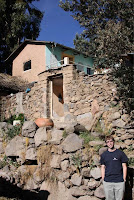
Our host house.
During lunch, my friend the Tourism General (Benjamin Linus) of Amantani paid a visit. He smiled too much and was super fishy. He told us, in Spanish, that "Your tour guide doesn't want to pay the full 30 soles per person for the host family and rather he's only paying 25." He went on to imply that if the guide only paid the 25, he would need us to pay 30 so the family would get their money for hosting us. That math didn't add up. 30-25=5, so if that story were true, we'd only need to pay an extra 5 soles, not 30. We never had to pay the 30 extra soles so it seems the tourism dude was just trying to squeeze more money out of us. Either way it's not a lot of money, but we had been assured by the tour company that everything was paid for. It's really tiring when it seems everyone is trying to scam you.

After lunch we met back up with the tour group and started a trek up to Pachatata at about 4:30, which is a temple to father earth. It's at the top of the island. Lake Titicaca is the second highest plateau in the world and the Pachatata temple is the highest point on the lake at 13,350 feet. It's hard to explain how tiring it is to walk up-and-up-and-up at that elevation. You're hardly doing any work at all, but you're out of breath the whole time.
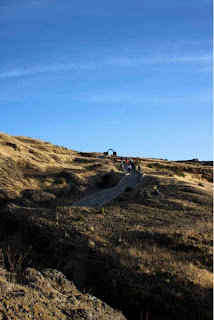
The long walk up the mountain.
The walk is incredibly exhausting and it just seemed to keep going and going and going. It was the Energizer Bunny of walks up island mountains.
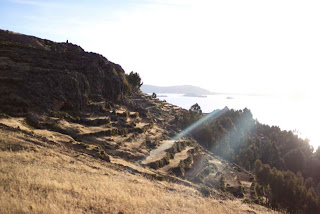
View of the mountainside.
We arrived at the top just before 6:00. Right as the sun was setting. We didn't get to go in the temple but that was alright. Someone must have captured the smoke monster in there.
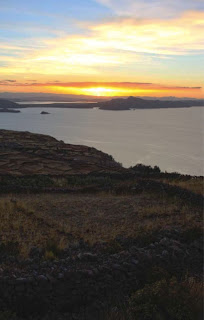
Sunset from Pachatata.
Supper was similar to lunch and just as great. We had a tea similar to coca, but mintier. It's called muña. Similar to coca it helps to treat headaches and stomach aches. Afterward we spent a long time checking out the stars and talking to Rousseau and Clouseau. They were very impressed by all the stars, because they can't see them through the light pollution in France. Even though we're in the deep deep south, you can still see the big dipper. The little dipper, however, is just below the horizon.

Lake Titicaca: LOST Style (part 3)

Host house's kitchen in the morning.
Still on Amantani breakfast was pancakes, YEEHAW, and bread and coffee. Afterward we boarded the boat and headed off towards another island: Tequile (might as well be Hydra island though). All of these islands (minus Uros) are mountains as well as islands. At Tequile we hiked up the mountain and across the island--just like John Locke--for a good hour before we got to the main plaza. On the way we saw people farming and just being normal island people. We also passed the Flame Dharma station.
The Flame Dharma station.
Once we got to the plaza we looked around a bit and then went to a house where we got an explanation of the different weaving that the island is known for. I guess they're famous for their fine weaving, as fine as that tapestry Jacob's always weaving. Afterward we had lunch of trout, great soup, rice, bread, french fries, and tea. I'm getting to be a big tea fan.

After about a million steps down the other side of the island we boarded the boat and headed back to Puno. Thus ended the great trip to Lake Titicaca.


← Previous Page

Blogs I Read

Powered by Blogger.