My grandparents were right

Just before leaving for Peru my grandparents asked if I had packed peanut butter. They told me that I'd want some as a taste of home down in Peru. I thought, Oh I've never been homesick so that won't be a problem. Nevertheless, peanut butter sounded like a good idea so I planned on getting to the store before leaving Bismarck to go pick some up. In the rush of finishing packing, I forgot to make that trip.

Flying somewhere over the U.S. I remembered that I forgot to make that trip. It would have been nice, but I'll be fine, I thought. And for a while I was fine.

A short while though. About a week after arriving I came down with giardia, and at that point there was nothing I wanted more than a taste of home. It was peanut butter that I was craving, and the craving never stopped. One day, in fact, I payed over $2.00 just for a Reese's (which are a rare animal here). They simply don't eat peanut butter down here in Peru. It's nowhere to be found.

But I kept looking, and just a few days ago I found some peanut butter. A month and a half of looking in every shop for peanut butter and now I have some. It cost 19.00 soles which comes to around $8.00 but it was worth it, because my grandparents were right. When you're traveling for an extended period of time it's really nice to have a taste of home.

Cold canned coke


On Sunday Brandon and I caught a tour of the Sacred Valley of the Incas. It included a few different ruins and a great lunch. After leaving the last site at Ollantaytambo, the (amazing) water temple, we were just about on the bus when Brandon noticed something.

Coke is very common here in Peru in plastic bottles and glass Cokes are abundant as well. But for whatever reason cans of anything are very rare. I've only seen 2 or 3 little shops that carry cans of Coke, and you've got to take advantage of those opportunities. They are few and far between.

It's also common for pop to be in refrigerator displays--like you'd see at the grocery store--but it's very uncommon for those displays to be turned on and keeping the pop cold. Why? I can't figure out why you'd buy the display and not turn it on, but maybe they come free or something.

But on this occasion what Brandon noticed was a fridge display of cold cans of Coke. The stars had aligned. I jumped on this opportunity without any hesitation because a can of Coke is far superior to a bottle of it. There's just something worlds better about it (although fountain Coke is, in my opinion, the best).

Peru made potatoes first

There are 1000s of different potato species.
Did you know that potatoes came from Peru? I feel like we learned that in World History one year, so when someone told me that this summer, my brain went Oh yeah. Anyway, the people here know it and they really love it too. And they really love the potato: it's in almost every dish I've had since arriving a month ago.

The Incans or pre-Incans were the first to domesticate the potato some time between 8000 and 5000 B.C. Then they fell in love. We, myself and the scientists, believe that Spain brought the potato back to Europe some time in the 16th century while they were conquistadoring down in Peru. And then the world fell in love with the potato.

Today there are thousands of distinct species of potato and all ones I've tried down here have been pretty great. I'll be eating some great french fries—which are served at tons of meals—only to find they aren't french fries at all, but some potato-cousin-fries.

Peru, I'd like to thank you.

Awanakancha

Feeding the baby llama.
I forgot to write anything about Awanakancha. It's a little, pretty touristy, "village" outside of city called Pisac. This was one of the first places that I visited, it was during my first or second week in Peru. Every week Projects Abroad organizes a social for all the volunteers in Peru, and going to Awanakancha was one of those socials.

Mom and baby alpacas.
So, there are a few things that Awanakancha is all about:
  • Llamas, 
  • Alpacas, 
  • A few undomesticated cousins of the llama/alpaca family, 
  • Potatos and corn, and 
  • Weaving and weaved goods.

Beyond being about those aforementioned items, the place is also all about letting you feed, pet, and ride the llamas and alpacas! (I'm lying about the riding part) It was a lot of fun. I had no idea that these animals were so docile and friendly—I didn't think they were vicious of course, but it turns out they really want to be your friend... especially if you have the grass they like.

The potato and weaving parts of Awanakancha almost come as an afterthought. However, they were still pretty interesting to learn about. I'll have a separate post about potatoes tomorrow so for now I'll talk about weaving for a second and then leave you in peace.

The picture to the left is an example of how various peruvian natives weave using a special type of loom. I don't know much about that process other than it takes a long time and they use a llama bone during the process. The coloring process is pretty interesting. First they have to spin the alpaca fur/wool into string/yarn. Then, using various bugs, herbs, or other organic means, they give the string/yarn its different colors through boiling it with dyes. Red dye, for example, is made by crushing a certain insect.

It was interesting to learn about the weaving and potatoes of Peru, but the best part by far was hanging out with llamas and alpacas.

Lake Titicaca: LOST Style (part 2)

The Island... of Amantani.
Departing from Uros, we set out to find the island Charles Widmore style. It was a 3 hour boat ride to get to Amantani. There were awesome people in our tour, and most of the 3 hours was spent talking to them. An uncle and nephew from Idaho, 2 Australians, 2 French couples, a German, and a girl from the US who's working for an NGO in Lima. Topics of conversation ranged from "Money Ball" to the process of learning languages. It was a good boat ride.

The boat docked at the island… of Amantani at about 1:30 pm. From there we were all given a host family for the night. A French couple (might as well have been Rousseau of LOST and Inspector Clouseau from the Pink Panther), Brandon, and I got a family that seemed to live on the top of the island. Lake Titicaca sits at 12,000 feet above sea level. That's about 2 miles closer to the moon than any part of North Dakota. At the family's house in the clouds we were served fantastic soup, potatoes, cheese, and tea. The soup was a potatoey-vegetabley-spice deal that was very filling. Then came potatoes (of a variety that is only grown on this island), cheese, bread, and coca tea. So good.
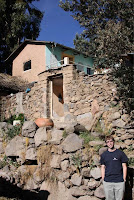
Our host house.
During lunch, my friend the Tourism General (Benjamin Linus) of Amantani paid a visit. He smiled too much and was super fishy. He told us, in Spanish, that "Your tour guide doesn't want to pay the full 30 soles per person for the host family and rather he's only paying 25." He went on to imply that if the guide only paid the 25, he would need us to pay 30 so the family would get their money for hosting us. That math didn't add up. 30-25=5, so if that story were true, we'd only need to pay an extra 5 soles, not 30. We never had to pay the 30 extra soles so it seems the tourism dude was just trying to squeeze more money out of us. Either way it's not a lot of money, but we had been assured by the tour company that everything was paid for. It's really tiring when it seems everyone is trying to scam you.

After lunch we met back up with the tour group and started a trek up to Pachatata at about 4:30, which is a temple to father earth. It's at the top of the island. Lake Titicaca is the second highest plateau in the world and the Pachatata temple is the highest point on the lake at 13,350 feet. It's hard to explain how tiring it is to walk up-and-up-and-up at that elevation. You're hardly doing any work at all, but you're out of breath the whole time.
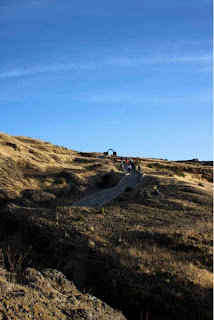
The long walk up the mountain.
The walk is incredibly exhausting and it just seemed to keep going and going and going. It was the Energizer Bunny of walks up island mountains.
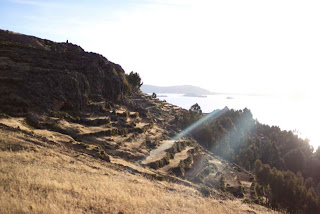
View of the mountainside.
We arrived at the top just before 6:00. Right as the sun was setting. We didn't get to go in the temple but that was alright. Someone must have captured the smoke monster in there.
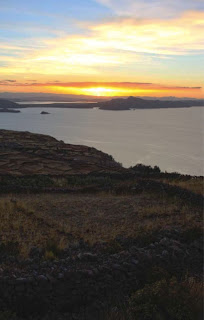
Sunset from Pachatata.
Supper was similar to lunch and just as great. We had a tea similar to coca, but mintier. It's called muña. Similar to coca it helps to treat headaches and stomach aches. Afterward we spent a long time checking out the stars and talking to Rousseau and Clouseau. They were very impressed by all the stars, because they can't see them through the light pollution in France. Even though we're in the deep deep south, you can still see the big dipper. The little dipper, however, is just below the horizon.

Lake Titicaca: LOST Style (part 3)

Host house's kitchen in the morning.
Still on Amantani breakfast was pancakes, YEEHAW, and bread and coffee. Afterward we boarded the boat and headed off towards another island: Tequile (might as well be Hydra island though). All of these islands (minus Uros) are mountains as well as islands. At Tequile we hiked up the mountain and across the island--just like John Locke--for a good hour before we got to the main plaza. On the way we saw people farming and just being normal island people. We also passed the Flame Dharma station.
The Flame Dharma station.
Once we got to the plaza we looked around a bit and then went to a house where we got an explanation of the different weaving that the island is known for. I guess they're famous for their fine weaving, as fine as that tapestry Jacob's always weaving. Afterward we had lunch of trout, great soup, rice, bread, french fries, and tea. I'm getting to be a big tea fan.

After about a million steps down the other side of the island we boarded the boat and headed back to Puno. Thus ended the great trip to Lake Titicaca.


Corpus Christi

Woman making chiriuchu.
First let's talk about "chiriuchu." It's the main food at the festival that I'm about to talk about. It is chicken, tortillas, rice, other stuff, and whole guinea pigs! Guinea pigs. If you look at the above picture you can see the guinea pigs off to the left. They still have their teeth.

No festival is complete without tons of live music.

The Corpus Christi festival was two Thursdays ago. I don't know what it's a festival of, I just keep hearing that "it's very Catholic."  Anyway it consists of TONS of people, throngs of them, carrying huge statues of saints around the Plaze de Armas. The place was packed. And some of these saint statues were threatening to crush the 20-30 people who were hoisting them around. No procession would be complete with out music and flags, and Corpus Christi is in no short supply of either.
A bunch of people at the Corpus Christi Festival.

During the festivities, one saint caught my eye. This saint rode a horse, how chivalrous. This saint was also crushing an Incan. You have to ask "why?" And I did. What happened was the Incans had the Spanish surrounded, so many 100s of years ago, in the very plaza that the saint statues were being carried around in now. The Incans had a sure victory on their hands until… this saint--Saint Sebastian I think--came storming in on a horse from somewhere and started just destroying Incans: crushing, stomping, slashing. Now this was a saint! And the Spanish ended up winnning this battle and Saint Sebastian was ever remembered as an Incan crusher. Can you imagine! Let's see that pass as politically correct in the US, shall we.


The saint, crushing an Incan.


← Previous Page

Blogs I Read

Powered by Blogger.