World Ovarian Cancer Day


I found out earlier today that it is the first ever World Ovarian Cancer Day. The purpose of the day is to get everyone to send a consistent message about ovarian cancer — for at least one day. Remembering my mom's struggle and our family's, I decided to post the following to Facebook:

—————

13 years ago my mom knew two things: that she had ovarian cancer and that it had been caught late, just like in 85% of cases, which meant that she had less than a 50% chance of seeing any of her kids enter high school. Not catching it early is ugly but she beat the statistics for a long time. 10 years. She was atypically strong and had support from so many great people — and our family could never thank you all enough.

Eventually though, it's not a matter of strength or support; not a matter chemo or promising new treatments. Eventually — if it's caught late — it's not a matter of recovery because ovarian cancer is exponentially more deadly after its been given a chance to make a footing.

3 1/2 years ago my mom was one of the 14,000 US women to die wounded from a too-late a fight with ovarian cancer.

Cancer is treatable. Even ovarian cancer. The 15% of women who get diagnosed early make it 5 years with 93% certainty. Today on the first World Ovarian Cancer Day we would do well to know two things:

1) These symptoms of ovarian cancer warrant a check-up:
  • Increased abdominal size / persistent bloating (not bloating that comes and goes) 
  • Difficulty eating/feeling full quickly 
  • Abdominal or pelvic pain 
  • Needing to pass urine more urgently or more frequently 
2) That detecting cancer — of any type — late is a waste; it can usually be caught early because we have the screenings and exams to do so. Caught early, it can be treated effectively.

And really, detecting most diseases at most stages is a waste. Living healthier and seeking preventative medicine, we can prevent a majority of the diseases that ruin our quality of life and lead to an empty seat at the table. The most advanced treatments in the world aren't nearly as ideal as never having to consider them.

—————

It's one of the most deadly cancers for a woman to get because of how late it's usually diagnosed. That was the case with my mom's cancer and, although she fought like hell, ovarian cancer added one more woman to its long victim list.

I'd urge anyone with those symptoms to go in and get them checked out. You can't lose; either you don't have cancer (but also a little lighter in the wallet) or you might be able to catch it early when the 5 year survival rate is better than 90% (instead of catching it late when it's worse than 50%).

It's not "give a fish vs. teach to fish"

I'd like to be more bipartisan, and I try all the time — because the right gets it Right a lot. They're right to want to say "get up and do something about your life," because at some point it comes down to each of us individually. At some point we've got to decide to climb a little higher if we're going to leave life better than we came in. The Right says TEACH a man to fish.

The Left gets it right too though. Not everyone can make that first step. Some people are born into a situation where they're first step is booby-trapped. For some people it's not just a first step, but a leap like Batman made to get out of the pit in The Dark Knight Rises — and it took Batman more than one try by the way. The Left says GIVE a man a fish.

So I'd like to be bipartisan. But the fact is that the choice isn't between GIVE a fish or TEACH to fish. If that was the choice then you'd find me on the Right.

The fact is that the Left is filling a need when they're giving a man a fish and the right isn't teaching anyone to fish. Some people do, don't get me wrong; some people are really helping people get out of where they came from by teaching them everything they know about fishing. Some people do, but that's not the Right, it's just people, and it's too few people.

The Left, through programs and welfare are filling the need of giving people that first fish, that first leg up. Sure they don't do a good job of the follow-up and absolutely necessary teaching about fishing. But no one is doing a good job there, and the Right isn't offering that as an alternate choice.

The Right says get rid of welfare, but doesn't offer to replace it with an option. That's ridiculous. It's stupid. And it's neglectful. The people who need welfare in order to some day climb out of their situation then have no fish and no fishing rod and no knowledge about the secret fishing spots that many of us take for common knowledge.

So it's not "give a fish vs. teach a fish." The choice I see offered to the American people is "give a fish vs. keep the fish for ourselves and hopefully a few of our teachers out there devote their lives to finding and teaching our at-risk populations as much about fishing as they can on their own dime."

Neither is perfect, but at least we're doing something when we offer that first bit of good will.

9/11 commemorated by Arabic club

The Minot State University Arabic Club is holding an event on September 11th. The Minot Daily News, in pyramid format, started their article of the event like this:
Minot State University's new Arabic club hopes to promote better understanding of the Muslim community with a cultural event scheduled the anniverary of the Sept. 11, 2001 attacks.
Really?! No way, I thought. Not on the anniversary.

Yeah, I get that it wasn't all of Islam (or everyone that speaks Arabic), that attacked the US on that day and that the Minot Daily News is/has-for-years-been clearly biased (which is why the article starts so destructively) and I really truly believe that it's the right thing to do to foster better understanding between America—the Minot community included—and the Arabic world, but...

And then I couldn't finish my thought; I thought But what? But what?

But what?

After first admitting to myself that Americans have a generally bloated and prejudiced aversion to the Arab world (certainly to Islam), I could only finish my thought by adding but September 11th isn't the right day... And to take it one step further—to explain why it's not the right day—I had to add because September 11th is very sad for us and we want to be angry. 

An event that supports and hopes to spread understanding between Muslims and Americans shouldn't be on that day, I thought.

Then I thought about my thoughts (a talent which, when utilized, makes us human and separates us from the rest of the animal kingdom). Two things injured me when I introspected. First, Muslims and Americans are not mutually exclusive groups; in fact we have a Muslim community in Minot. Why did my thoughts naturally place them as separate groups? Second, I couldn't believe that I had rationalized my negative reaction to the event by admitting that we, as Americans, would rather spend the day being angry than being even a little open to the possibility that we shouldn't hate an entire religion.

Because if we step outside of our ridiculous media, and biases, and emotions, we can see the world for what it really is.

In the real world, terrorists bombed the Trade Center on 9/11. They used planes, and citizens, and so very many people died, and the terrorists were Muslim. In fact, the terrorist group they were a part of claimed to be supporting Islam with their acts. Another fact: most Muslims can't reconcile the attacks with their belief and faith in Islam. They can't believe that people could read their holy book in such a way to lead to such a tragedy. They hate the attacks just as much as non-Muslims do.

September the 11th is a very sad day for Americans. We were attacked. We lost our family members and friends. We didn't feel safe in our own homes. And we remember just where we were each year on its anniversary. However, we've grown to hate entire groups of people out of misguided—deliberately misguided—anger. September 11th is a day to be sad, to remember, to re-center ourselves...

But.

September 11th can no longer be a day we also set aside to be angry, to condemn an entire culture, to hate.

It's not the perfect day to promote better understanding, but it's just as good as any other, and maybe even a bit better because it brings our prejudices out into the open where, hopefully, we can see them for how ugly they really are.

Independence: Climbing Huaynapicchu


My ticket for Machu Picchu included a ticket to climb a lesser known, ableit in-plain-sight, land mark: Huaynapicchu. It's the mountain looming behind Machu Picchu in every postcard of the place that you've ever seen (I have a picture like I'm talking about on my post "See"). I was going to climb it to the peak, a la cima.

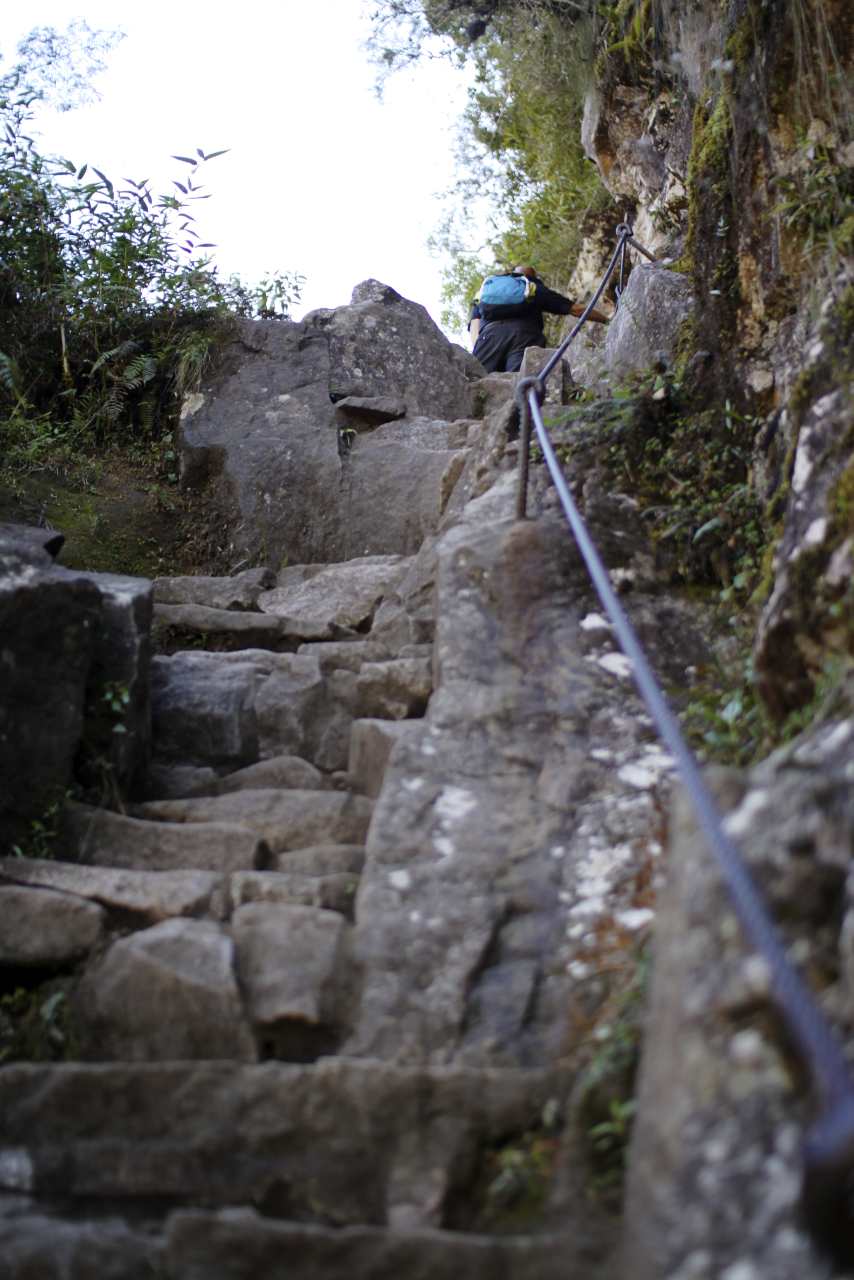
The path.
The steps—the climb—up to the top was made by the Incas. The steps are steep, but when they get really steep there's a rope (which was not made by the Incas). However, about two-thirds of the way up the trail takes a break from steps. Now the trail was just a steep, narrow trail of mountain. Here and there you'd get that rope, but more often than not you just relied on your balance and footing as you climbed ragged rocks up and up and up. You look over the edge, which is inches from you, and see just how high you are and just how easy it would be to make a mistake and fall off the mountain.

At this point it struck me: if something were to happen, there's no one to fall back on. There aren't park rangers or security guards on the mountain. If you were step wrong and shatter your ankle, there's no way you're getting down the mountain without using that same ankle. If you have a heart attack, there's no one to call for a helicopter—and if there were it would be impossible for the helicopter to pick you up from the mountain side. If you trip and fall, you could actually plummet from the side of the mountain.

Huaynapicchu.
We were all tourists climbing this mountain, but we were each entirely alone, entirely responsible for ourselves, entirely independent. It was not entirely familiar for me. My dependence was wrenched from me because Huaynapicchu rendered it impossible to hold onto. It was empowering. More so than at any other time in my life, I felt a powerful sense of being alone; alone in the sense of being a lone one: a lone person, independent of all others. Not a sense of irresponsibility of my effect on others, but a sense of total responsibility for my effect on myself.

At the top of Huaynapicchu I looked around and saw everyone else who had hiked to the peak as well, all on our own, each one of us. I've never felt or been quite as accountable for my actions as at that moment. Going back down the mountain the feeling stayed with me. The deep, clear breathes of independence at the peak of Huaynapicchu were very unfamiliar but very welcome.

Incans

Temple of the 3 Windows.
It's easy to look at Machu Picchu and think Wow, I can't believe how intelligent and organized you'd have to be to have created such an incredible place. Machu Picchu leaves you with this sense of awe because you see what human beings are capable of achieving. It's really an incredible place—it's insanely great.

The people behind the place are even more incredible, even insanely greater.

The Incans created an empire throughout what is now Peru through the traditional means of conquering but also through showing people a much superior way to live. This lifestyle that they believed in and lived was based on three tentpole guidelines:
  1. Don't Lie.
  2. Don't Steal.
  3. Don't be Lazy.
(The Temple of the 3 Windows served as a reminder of these three tentpole guidelines. You can find a Temple of 3 Windows at most Incan ruins for this reason.)

They boiled down, sifted through, and condensed the secret of life to just three guidelines. And it really worked for them. If you think about it, those three guidelines can well guide you through the day. The Incans and their empire were a testament to these beliefs; plus, they extrapolated on them.

The Incans had taxes, like all societies, but their taxes were a little different; your tax was a month of work per year for the empire: "Don't be Lazy." And the work was tough, but not what you think. There was constant music and plenty of food—not the slavery most societies have subscribed to. In fact when the Spanish came, they wrote of Incan work by noting that it was organized, joyful, voluntary, and that the workers sang as they works. Through this tax of work they were able to build incredible places such as Machu Picchu and Sacsayhuaman as well as build a free new home for every newlywed couple.

As I learned all of these things during our Machu Picchu tour, I was more and more impressed by the Incans. They really had things worked out. It's a little paradoxical that the Spanish were similarly impressed as they wrote again and again about how great and organized a society the Incans had, but then the Spanish turned around and killed and conquered that great society. It's a shame. These people were great.

← Previous Page

Blogs I Read

Powered by Blogger.