World Ovarian Cancer Day


I found out earlier today that it is the first ever World Ovarian Cancer Day. The purpose of the day is to get everyone to send a consistent message about ovarian cancer — for at least one day. Remembering my mom's struggle and our family's, I decided to post the following to Facebook:

—————

13 years ago my mom knew two things: that she had ovarian cancer and that it had been caught late, just like in 85% of cases, which meant that she had less than a 50% chance of seeing any of her kids enter high school. Not catching it early is ugly but she beat the statistics for a long time. 10 years. She was atypically strong and had support from so many great people — and our family could never thank you all enough.

Eventually though, it's not a matter of strength or support; not a matter chemo or promising new treatments. Eventually — if it's caught late — it's not a matter of recovery because ovarian cancer is exponentially more deadly after its been given a chance to make a footing.

3 1/2 years ago my mom was one of the 14,000 US women to die wounded from a too-late a fight with ovarian cancer.

Cancer is treatable. Even ovarian cancer. The 15% of women who get diagnosed early make it 5 years with 93% certainty. Today on the first World Ovarian Cancer Day we would do well to know two things:

1) These symptoms of ovarian cancer warrant a check-up:
  • Increased abdominal size / persistent bloating (not bloating that comes and goes) 
  • Difficulty eating/feeling full quickly 
  • Abdominal or pelvic pain 
  • Needing to pass urine more urgently or more frequently 
2) That detecting cancer — of any type — late is a waste; it can usually be caught early because we have the screenings and exams to do so. Caught early, it can be treated effectively.

And really, detecting most diseases at most stages is a waste. Living healthier and seeking preventative medicine, we can prevent a majority of the diseases that ruin our quality of life and lead to an empty seat at the table. The most advanced treatments in the world aren't nearly as ideal as never having to consider them.

—————

It's one of the most deadly cancers for a woman to get because of how late it's usually diagnosed. That was the case with my mom's cancer and, although she fought like hell, ovarian cancer added one more woman to its long victim list.

I'd urge anyone with those symptoms to go in and get them checked out. You can't lose; either you don't have cancer (but also a little lighter in the wallet) or you might be able to catch it early when the 5 year survival rate is better than 90% (instead of catching it late when it's worse than 50%).

Effective Change

We face a number of problems in our country and in our organizations. One of them is that we are largely ineffective at the work of bettering. We try to better this or that by incentivizing change, as though changing for the better were something that needed further incentive than its natural outcome. Another way we try to better our organizations or country is by mandate. We mandate as a method of bettering the behavior or workings of people or organizations.

This doesn't work.

There are many incredible organizations and people that give us hope that more could work in the same ways, but not everyone is ready. If an organization isn't ready to work efficiently then ensuring efficiency will not fix it. Paperwork is not an effective motivator. Betterment cannot be forced, but it can be planned for and supported.

El Gobierno Natural

The following is an essay I wrote for Hispanic Literature. It deals with an essay by José Martí titled "Nuestra América" which aims at emboldening the people of Latin America to renew their countries by renewing their government by ensuring that it is government that springs from the spirit of the people (instead of government that has just been inherited from Europe).

Nadie es su propio vecino; esto no es una atrevida afirmación, sino que es más como un comando en la obra “Nuestra América” por José Martí. Martí escribe porque es difícil no imitar a su vecino si su vecino tiene mucho éxito. En esa obra, Martí quiere envalentonar a la gente de su país y de todos los pueblos de América del Sur, su “América.” Quiere que América sea fuerte y sea nuestra América — no la de Francia ni de España ni de cualquier otro país en el occidental “civilizado.” A tal efecto, en el primer párrafo afirma: “Estos tiempos no son para acostarse con el pañuelo en la cabeza.” La visión de Martí para el futuro y el potencial de América era muy diferente a simplemente copiando de sus vecinos (porque creía esto era predestinado a fracasar), y porque era diferente él tuvo que tener mucho cuidado que iba a ser entendido correctamente. Para hacer esto, convencer a su pueblo levantarse, Martí utilizó una mezcla de elementos simples de la naturaleza y fórmulas complejas de la palabra escrita.

Primero, vamos a discutir la visión de Martí en particular. Vio que había un problema en su América y trató de diagnosticarla: descubrió que América estaba siendo gobernada por la lógica que funcionó... en otro lugar. No creía que esto pudiera funcionar, en cambio, cree que “El espiritú del gobierno ha de ser el del país.” América y Europa no son el mismo continente pero estaban siendo gobernados así. Para empeorar el problema, la comprensión común era que la problema no era la gobernanza, sino los gobernados. Con esta comprensión, la gente de su país no estaba lista oír que tenía su propio poder y voz. La gente pensaba que el mundo tenía razón y ellos estaban equivocados, que Martí vio evidenciado en la manera en que la gente trató de adoptar la cultura de Occidente. Él autor está harto de esta forma de pensar y escribe “Si son parisienses o madrileños, vayan al Prado, de faroles, o vayan a Tortoni, de sorbetes.” Él está escribiendo para la gente sencilla, incorrupta, y verdaderamente Americana.

Habla a la gente simple de América con la lengua simple. Con palabras que invocar imágenes vivas de la naturaleza y el trabajo Martí es capaz de pintar el futuro para la gente sencilla de la América que él imagina. Las más sencillas de su país no entendería si habló en términos del patriotismo, la unificación, ni de la autodeterminación; pero entenderán el poder del valor, marchando juntos, “trincheras de ideas”, y hablando con una sola voz. Hay muchos ejemplos en los cuales Marti invoca estas ideas. Para mover a su gente al valor escribe de aquellos sin ello: “A los sietemesinos sólo les fatará el valor.” Además, el autor delinea el poder de las ideas (para las personas que están más acostumbrados a resolver las cosas “con la mano”) por escribiendo que “Trincheras de ideas valen más que trincheras de piedra.” Estos dos ejemplos pinta una pintura para la audiencia y serán muy efectivos para comunicar la visión de Martí pero la pintura más vivas nos encontremos en línea 17:

Ya no podemos ser el pueblo de hojas, que vive en el aire, con la copa cargada de flor, restallando o zumbando, según la acaricie el capricho de la luz, o la tundan y talen los tempestades; ¡los árboles se han de poner en fila para que no pase el gigante de las siete legua!
Esto es una de las imágenes más estimulantes de la obra. Usa muchas palabras que dibujan imagenes en la mente, como hojas, aire, copa, flor, restallando, zumbando, luz, tempestades, y árboles; estas palabras juntas pintan una pintura de una gente incapaz y débil. La pintura habría hecho una conexión emocional fuerte con los que leerían esta obra: somos mejores que ‘el pueblo de hojas;’ somos fuertes, se animarán a pensar.

Pero Martí tambien necesita hablar y animar a la gente más sofisticada quién adora la Europa (pero ójala que adore más la América). Para hacer esto él habla de su idea, que es muy anti-europea, en lo que parece ser el tono de voz de la misma Europa. Es rápido en castigar a aquellos que valoran las costumbres europeas más altas que las formas naturales de América, pero lo hace en un estilo de escritura que permite que aquellas mismas personas no convertirse en autoconsciente suficiente para que ellos son el problema. Hacerlo así permite que él gane a este colectivo que de otro modo podría alejar.

Un buen ejemplo de este estilo de escribir se puede encontrar en linea 105. Comienza con “Y como el heroísmo en la paz es más escaso, porque es menos glorioso que el de la querra; ....”, pero parece que nunca va a terminar. La oración es 236 palabras de largo y contiene una mezcla de 23 comas y puntos y coma; no es una oración para el campesino analfabeto. Este tipo de oración es común en los escritos de los grandes filósofos de la Grecia y Roma. Pero, como sabemos, Martí no adora en el altar “de los filósofos clásicos.” De hecho algunas oraciones antes de la oración maratonesca afirma que “Nuestra Grecia es preferble a la Grecia que no es nuestra,” que es dicer tenemos que construir nuestro propio mundo con nuestra propia sabiduria.

Después de la labor de unir a la gente común y sofisticados en el mismo cuarto, Martí puede profudizar más en lo que él cree que va a solucionar muchos de los problemas de América: el gobierno natural. Esto es el corazón de su filosofía del gobierno, que el gobierno tiene que “nacer del país”:

El gobierno ha de nacer del país. El espíritu del gobierno ha de ser el del país. La forma de gobierno ha de avenirse a la constitución propia del país. El gobierno no es más que el equilibrio de los elementos naturales del país.
Sigue profundizando cuando escribe que “No hay batalla entre la civilización y la barbarie, sino entre la falsa erudición y la naturaleza.” Sólo ha de entender el país:

Se ha de tener fe en lo mejor del hombre y desconfiar de lo peor de él. Hay que dar ocasión a lo mejor para que se revele y prevalezca sobre lo peor. Si no, lo peor prevalece.
Martí cree que las problemas de las Américas se pueden solucionar por entender realmente y afirmar el espíritu de las Américas.

En la película “Japón,” por Carlos Reygadas, vemos lo que pasa (después de muchos años) de una gente gobernada en una forma que contraviene el espíritu de la gente. Al principio parece que la gente ha perdido su camino, pero después del análisis nos damos cuenta de que no es el pueblo que está mal, sino el gobierno; el gobierno es la “falsa erudición.” En la oración maratonesca de antes Martí explica lo que estoy subrayando. El gobierno es malo porque obliga a la gente a tratar de vivir según “elementos discordantes y hostiles que heredó de un colonizador despótico y avieso.” ¡La gente no puedo hacerlo! Es imposible vivir en un modo que contraviene el espíritu. No es que el modo de gobernar es malo ni que el espíritu es la de la barbarie, sólo que los dos son diferentes y no se combinan armoniosamente. Sigue, diciendo que, con la apoya de la gente, América se puede cambiar y rehacerse de acuerdo con el espíritu propio. Más que cualquier revolución, este cambio liberaría verdaderamente América, “Nuestro América.”

Es una verdadera lástima que América Latina se encuentra en la posición en que Martí escribe sobre, pero él tenía una gran visión del camino adelante. Vio que es imposible sólo imitar lo que puede trabajar para un vecino, porque nadie es su propio vecino y puede ser que lo que funciona para ellos no va a funcionar para nadie más. También vio una necesidad de hablar con toda la gente de América, no sólo el hombre común y no sólo el aristócrata; América se necesita ambos. Para hacer esto él usó imágenes concretas de la naturaleza mezcladas con lenguaje sofisticado. Pidió a todos sus publicos con el fin de unir a la gente que amaba a lograr un cambio que beneficiaría a todos. América Latina todavía tiene muchos problemas y el camino es difícil en el futuro pero hay un camino adelante. El concepto de Martí de un gobierno que nace del espíritu del pueblo — en vez de Europa —, un gobierno natural, puede ser el camino perfecto para seguir.

Prevention vs. Cure

My professor read this poem to us. It highlights a common mistake that we make: focusing more on ways to cure illness rather than prevent it.

"The Ambulance Down in the Valley"

'Twas a dangerous cliff, as they freely confessed,
Though to walk near its crest was so pleasant;
But over its terrible edge there had slipped
A duke, and full many a peasant.
The people said something would have to be done,
But their projects did not at all tally.
Some said "Put a fence 'round the edge of the cliff,"
Some, "An ambulance down in the valley."

The lament of the crowd was profound and was loud,
As their tears overflowed with their pity;
But the cry for the ambulance carried the day
As it spread through the neighboring city.
A collection was made, to accumulate aid,
And the dwellers in highway and alley
Gave dollars and cents--not to furnish a fence--
But an ambulance down in the valley.

"For the cliff is all right if you're careful," they said;
"And, if folks ever slip and are dropping,
It isn't the slipping that hurts them so much
As the shock down below--when they're stopping."
So for years (we have heard), as these mishaps occurred
Quick forth would the rescuers sally,
To pick up the victims who fell from the cliff,
With the ambulance down in the valley.

Said one, in a plea, "It's a marvel to me
That you'd give so much greater attention
To repairing results than to curing the cause;
You had much better aim at prevention.
For the mischief, of course, should be stopped at its source;
Come, neighbors and friends, let us rally.
It is far better sense to rely on a fence
Than an ambulance down in the valley."

"He is wrong in his head," the majority said,
"He would end all our earnest endeavor.
He's a man who would shirk this responsible work,
But we will support it forever.
Aren't we picking up all, jut as fast as they fall,
And giving them care liberally?
A superfluous fence is of no consequence
If the ambulance works in the valley."

But a sensible few, who are practical too,
Will not bear with such nonsense much longer;
They believe that prevention is better than cure,
And their party will soon be much stronger.
Encourage them then, with your purse, voice and pen,
And while other philanthropists dally,
They will scorn all pretense and put up a stout fence
On the cliff that hangs over the valley.

Better guide well the young, than reclaim them when old,
For the voice of true wisdom is calling,
"To rescue the fallen is good, but 'tis best
To prevent other people from falling."
Better close up the source of temptation and crime
Than deliver from dungeon or galley
Better put a strong fence 'round the top of the cliff
Than an ambulance down in the valley.
 (by Joseph Malins as posted here)

Going to Africa


God is good and I'm being sent on another adventure because of that fact. I was chosen to be one of the four people invited to go to the Central African Republic (CAR) this April. 

Yes, that's in Africa. 

I'm visiting as a member of Western North Dakota synod of the ELCA. The Evangelical Lutheran Church of the Central African Republic (EELRCA) is a sister synod of ours — they've sent people to ELCA events in the U.S. and we're now reciprocating by visiting them. We have a lot to learn from each-other.

I'll be attending a Lutheran youth conference, learning about the CAR and the EELRCA, and traveling to other sites that the ELCA has been involved with over the years. One place I'm especially excited to see is the clinic that will be getting internet (for the first time) thanks to donations from Sunne Lutheran Church of Wilton.

The CAR is one of the poorest countries in the world. On the Human Development Index it ranks 179th out of 182 countries. It'll be pretty eye-openning to see what that means for the people whose home is the CAR.

There are 2 primary languages: French and Sango. I've looked, but found very-very little about Sango (except what's on Wikipedia). I'll keep looking for more — the language is structured in a pretty sweet way.

Thanks for your support as I prep for this adventure.

It's not "give a fish vs. teach to fish"

I'd like to be more bipartisan, and I try all the time — because the right gets it Right a lot. They're right to want to say "get up and do something about your life," because at some point it comes down to each of us individually. At some point we've got to decide to climb a little higher if we're going to leave life better than we came in. The Right says TEACH a man to fish.

The Left gets it right too though. Not everyone can make that first step. Some people are born into a situation where they're first step is booby-trapped. For some people it's not just a first step, but a leap like Batman made to get out of the pit in The Dark Knight Rises — and it took Batman more than one try by the way. The Left says GIVE a man a fish.

So I'd like to be bipartisan. But the fact is that the choice isn't between GIVE a fish or TEACH to fish. If that was the choice then you'd find me on the Right.

The fact is that the Left is filling a need when they're giving a man a fish and the right isn't teaching anyone to fish. Some people do, don't get me wrong; some people are really helping people get out of where they came from by teaching them everything they know about fishing. Some people do, but that's not the Right, it's just people, and it's too few people.

The Left, through programs and welfare are filling the need of giving people that first fish, that first leg up. Sure they don't do a good job of the follow-up and absolutely necessary teaching about fishing. But no one is doing a good job there, and the Right isn't offering that as an alternate choice.

The Right says get rid of welfare, but doesn't offer to replace it with an option. That's ridiculous. It's stupid. And it's neglectful. The people who need welfare in order to some day climb out of their situation then have no fish and no fishing rod and no knowledge about the secret fishing spots that many of us take for common knowledge.

So it's not "give a fish vs. teach a fish." The choice I see offered to the American people is "give a fish vs. keep the fish for ourselves and hopefully a few of our teachers out there devote their lives to finding and teaching our at-risk populations as much about fishing as they can on their own dime."

Neither is perfect, but at least we're doing something when we offer that first bit of good will.

Throwback: "Snow Flake Breakdown"

Well it’s about time!

Minot High School caught up with the times this year and adopted a winter semi-formal. The times have managed to elude MHS since its very first winter, but no more! Many other state high schools have been sporting similar wintry dances for years now. Hopefully the Snow Flake Break will become an annual tradition.

What is commonly called a Snow Ball, we are calling Snow Flake Break. And first off, I’d better make it clear that a “Snow Ball” is not the same as a “snowball.” A snowball is a spherical object made of snow, while a Snow Ball refers to a fancy (or in our case semi-fancy) dance held in the wintertime.

Winter dances date all the way back to the Russian Revolution in 1917. A group of college students were putting together a dance and wanted a new “catchy” name. They had just been to the Ice Ball (during Russia’s ice season) and a clever young Russian came up with Snow Ball, or снежок (snye-ZHAWK).

It was a big hit and the Snow Ball has been with us, humans, ever since. The same can’t be said for the Ice Ball however. It’s dreadful temperatures and prevalent ice lead to its last appearance in the year 1922.

The Russian Snow Ball was always a week-long affair and featured different activities for each night of the week. There was ice-skating, ice-fishing, ice-scraping, an ice-sculpting competition, and finally the Ball on Friday night (weather permitting of course).

The Snow Ball has been held every year since 1917 in Russia and today is as rich with tradition as Christmas. Being so popular, the tradition started to branch out to other countries but really gained speed in the 20’s.

Not long after the first commercial radio broadcast in 1920, news of the Russian’s winter dance and festivities spread to all snow-covered corners of the world. It swept the world by storm and was “the Bee’s Knees” for roughly ten years but slowly lost popularity and came to be celebrated with about as much enthusiasm as Arbor Day.

The Snow Ball was revived triumphantly during the late fifties in England and came with the Beatles to America in 1964. The first Snow Ball in the U.S. was held in a vague town in Rhode Island the following year but was called a Winter Formal because it was “more American.”

The Winter Formal spread fiercely through the U.S. and became especially popular in high schools, where the majority of them are held today. The celebration still lasts one week but the traditional Russian ice-tivities are now replaced with more American activities that vary with each Formal. All, however, are more fun than ice-scraping.

Since the turn of the Millennium, Winter Formals have started to include a dinner party before their Friday dances with the hopes of relieving the stress on stressed students having to make reservations for dinner. The dinner has been widely enjoyed, and plus, you’re guaranteed a seat!

Though a Snow Ball has been discussed for years at MHS, this year we made the commitment and became a tri-dance school. We are very proud to be a part of the Earth’s tradition of wintry themed dances. You can all give yourselves a pat on the back; well done, team!

9/11 commemorated by Arabic club

The Minot State University Arabic Club is holding an event on September 11th. The Minot Daily News, in pyramid format, started their article of the event like this:
Minot State University's new Arabic club hopes to promote better understanding of the Muslim community with a cultural event scheduled the anniverary of the Sept. 11, 2001 attacks.
Really?! No way, I thought. Not on the anniversary.

Yeah, I get that it wasn't all of Islam (or everyone that speaks Arabic), that attacked the US on that day and that the Minot Daily News is/has-for-years-been clearly biased (which is why the article starts so destructively) and I really truly believe that it's the right thing to do to foster better understanding between America—the Minot community included—and the Arabic world, but...

And then I couldn't finish my thought; I thought But what? But what?

But what?

After first admitting to myself that Americans have a generally bloated and prejudiced aversion to the Arab world (certainly to Islam), I could only finish my thought by adding but September 11th isn't the right day... And to take it one step further—to explain why it's not the right day—I had to add because September 11th is very sad for us and we want to be angry. 

An event that supports and hopes to spread understanding between Muslims and Americans shouldn't be on that day, I thought.

Then I thought about my thoughts (a talent which, when utilized, makes us human and separates us from the rest of the animal kingdom). Two things injured me when I introspected. First, Muslims and Americans are not mutually exclusive groups; in fact we have a Muslim community in Minot. Why did my thoughts naturally place them as separate groups? Second, I couldn't believe that I had rationalized my negative reaction to the event by admitting that we, as Americans, would rather spend the day being angry than being even a little open to the possibility that we shouldn't hate an entire religion.

Because if we step outside of our ridiculous media, and biases, and emotions, we can see the world for what it really is.

In the real world, terrorists bombed the Trade Center on 9/11. They used planes, and citizens, and so very many people died, and the terrorists were Muslim. In fact, the terrorist group they were a part of claimed to be supporting Islam with their acts. Another fact: most Muslims can't reconcile the attacks with their belief and faith in Islam. They can't believe that people could read their holy book in such a way to lead to such a tragedy. They hate the attacks just as much as non-Muslims do.

September the 11th is a very sad day for Americans. We were attacked. We lost our family members and friends. We didn't feel safe in our own homes. And we remember just where we were each year on its anniversary. However, we've grown to hate entire groups of people out of misguided—deliberately misguided—anger. September 11th is a day to be sad, to remember, to re-center ourselves...

But.

September 11th can no longer be a day we also set aside to be angry, to condemn an entire culture, to hate.

It's not the perfect day to promote better understanding, but it's just as good as any other, and maybe even a bit better because it brings our prejudices out into the open where, hopefully, we can see them for how ugly they really are.

1950's science posters

Really, that's all this is about. It's just a link to a sweet page about some awesome posters. I hope you enjoy.

http://www.brainpickings.org/index.php/2011/12/16/vintage-science-ads-1950s-1960s/

Learning quechua

I've been interested in learning Quechua (a native Peruvian language) for all of about a month and a half. I haven't looked into it a lot, but I just found some information that I thought was interesting. And I've got to give credit to Barry Brian Werger who seems to have put together the website where I got this info.

Singular Plural
NOQA I NOQAYKU (exclusive)
NOQANCHEQ (inclusive)
we (and not you)
we (you and I or us)
QAN you QANKUNA you all
PAY he, she PAYKUNA they

One thing I really like is that Quechua has an exclusive "we" form to mean "we but not you." English and Spanish both lack this form so you can never tell if the speaker is including you or not.

Here's an example of how they conjugate words (simple present tense):

RIY - to go
Singular Plural
-NI RINI: I go -YKU
-NCHEQ
RIYKU: we go
RINCHEQ: we go
-NKI RINKI: you go -NKICHEQ RINKICHEQ: you all go
-N RIN: he/she goes -NKU RINKU: they go

I find it so interesting to see how a non-romance language is put together. Interesting tidbit though: the verb "to speak" in Quechua is parlay which is almost exactly what it is in French, parler.

Independence: Climbing Huaynapicchu


My ticket for Machu Picchu included a ticket to climb a lesser known, ableit in-plain-sight, land mark: Huaynapicchu. It's the mountain looming behind Machu Picchu in every postcard of the place that you've ever seen (I have a picture like I'm talking about on my post "See"). I was going to climb it to the peak, a la cima.

The path.
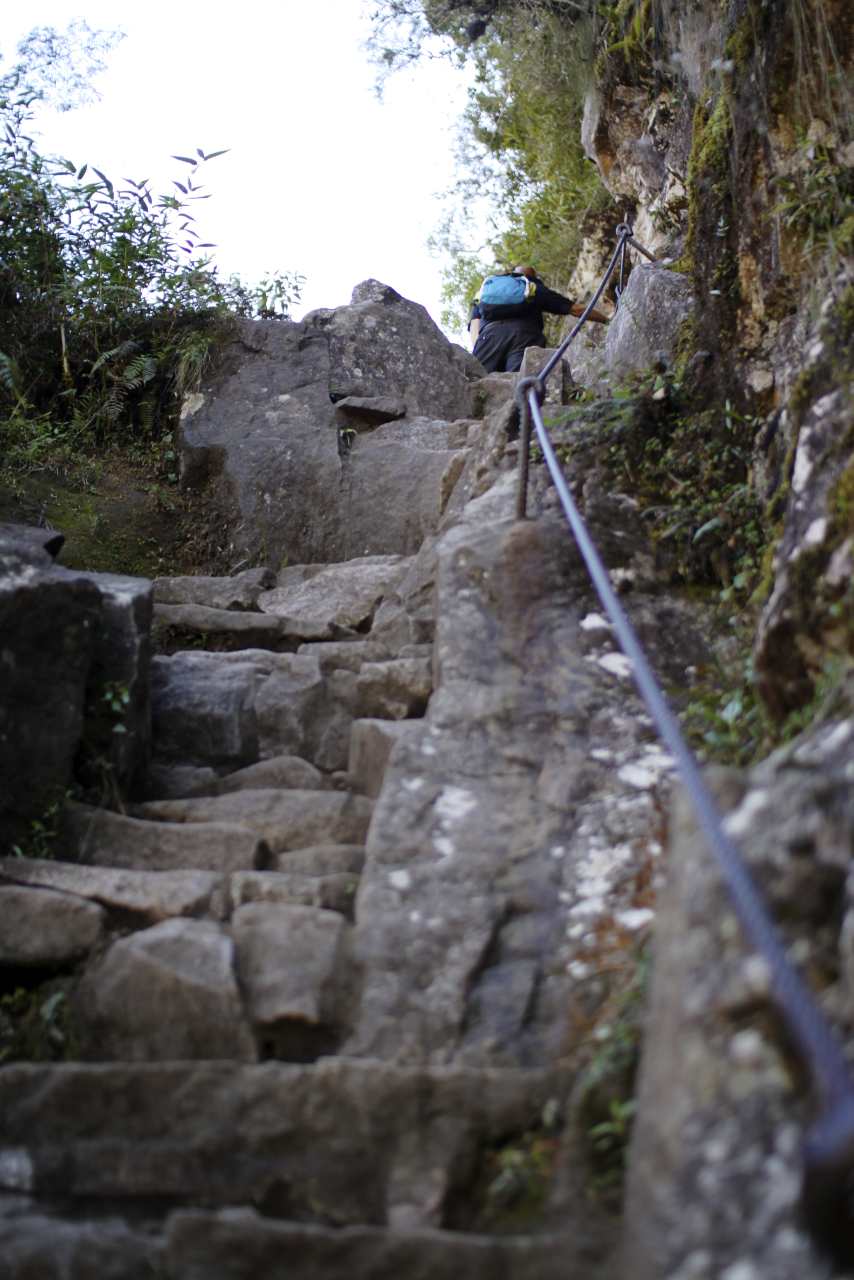
The steps—the climb—up to the top was made by the Incas. The steps are steep, but when they get really steep there's a rope (which was not made by the Incas). However, about two-thirds of the way up the trail takes a break from steps. Now the trail was just a steep, narrow trail of mountain. Here and there you'd get that rope, but more often than not you just relied on your balance and footing as you climbed ragged rocks up and up and up. You look over the edge, which is inches from you, and see just how high you are and just how easy it would be to make a mistake and fall off the mountain.

At this point it struck me: if something were to happen, there's no one to fall back on. There aren't park rangers or security guards on the mountain. If you were step wrong and shatter your ankle, there's no way you're getting down the mountain without using that same ankle. If you have a heart attack, there's no one to call for a helicopter—and if there were it would be impossible for the helicopter to pick you up from the mountain side. If you trip and fall, you could actually plummet from the side of the mountain.

Huaynapicchu.
We were all tourists climbing this mountain, but we were each entirely alone, entirely responsible for ourselves, entirely independent. It was not entirely familiar for me. My dependence was wrenched from me because Huaynapicchu rendered it impossible to hold onto. It was empowering. More so than at any other time in my life, I felt a powerful sense of being alone; alone in the sense of being a lone one: a lone person, independent of all others. Not a sense of irresponsibility of my effect on others, but a sense of total responsibility for my effect on myself.

At the top of Huaynapicchu I looked around and saw everyone else who had hiked to the peak as well, all on our own, each one of us. I've never felt or been quite as accountable for my actions as at that moment. Going back down the mountain the feeling stayed with me. The deep, clear breathes of independence at the peak of Huaynapicchu were very unfamiliar but very welcome.

Muestra de heces

Sixty-three.
Today you'll learn how to say "feces sample" if you look again at the title of this post. A week ago Brandon and I spent our days at the clinic working in the laboratory. It's a very interesting place to work. It's also really fun because the people in the lab are hilarious and really relaxed.

Most days the lab has been my favorite place to work because the people are so great. However, one Monday about a week ago, the lab was a pretty crappy place. Let's take that literally. On a regular day there are about 10 sample of urine, 15 samples of feces, and plenty of blood samples.

On the Monday I'm talking about there were 63 poop samples! It was a day full of a gracious amount of smells and I don't care to repeat it. The poop never stopped showing up at the window. We'd finish making 10 slides and then 10 more would magically appear—one of the worst kinds of surprises indeed.

Since that Monday I've worked more in the lab again (after really psyching myself up) but we've never come close to 63 poop samples again. You have to be thankful for small miracles.

My grandparents were right

Just before leaving for Peru my grandparents asked if I had packed peanut butter. They told me that I'd want some as a taste of home down in Peru. I thought, Oh I've never been homesick so that won't be a problem. Nevertheless, peanut butter sounded like a good idea so I planned on getting to the store before leaving Bismarck to go pick some up. In the rush of finishing packing, I forgot to make that trip.

Flying somewhere over the U.S. I remembered that I forgot to make that trip. It would have been nice, but I'll be fine, I thought. And for a while I was fine.

A short while though. About a week after arriving I came down with giardia, and at that point there was nothing I wanted more than a taste of home. It was peanut butter that I was craving, and the craving never stopped. One day, in fact, I payed over $2.00 just for a Reese's (which are a rare animal here). They simply don't eat peanut butter down here in Peru. It's nowhere to be found.

But I kept looking, and just a few days ago I found some peanut butter. A month and a half of looking in every shop for peanut butter and now I have some. It cost 19.00 soles which comes to around $8.00 but it was worth it, because my grandparents were right. When you're traveling for an extended period of time it's really nice to have a taste of home.

Cold canned coke


On Sunday Brandon and I caught a tour of the Sacred Valley of the Incas. It included a few different ruins and a great lunch. After leaving the last site at Ollantaytambo, the (amazing) water temple, we were just about on the bus when Brandon noticed something.

Coke is very common here in Peru in plastic bottles and glass Cokes are abundant as well. But for whatever reason cans of anything are very rare. I've only seen 2 or 3 little shops that carry cans of Coke, and you've got to take advantage of those opportunities. They are few and far between.

It's also common for pop to be in refrigerator displays--like you'd see at the grocery store--but it's very uncommon for those displays to be turned on and keeping the pop cold. Why? I can't figure out why you'd buy the display and not turn it on, but maybe they come free or something.

But on this occasion what Brandon noticed was a fridge display of cold cans of Coke. The stars had aligned. I jumped on this opportunity without any hesitation because a can of Coke is far superior to a bottle of it. There's just something worlds better about it (although fountain Coke is, in my opinion, the best).

Peru made potatoes first

There are 1000s of different potato species.
Did you know that potatoes came from Peru? I feel like we learned that in World History one year, so when someone told me that this summer, my brain went Oh yeah. Anyway, the people here know it and they really love it too. And they really love the potato: it's in almost every dish I've had since arriving a month ago.

The Incans or pre-Incans were the first to domesticate the potato some time between 8000 and 5000 B.C. Then they fell in love. We, myself and the scientists, believe that Spain brought the potato back to Europe some time in the 16th century while they were conquistadoring down in Peru. And then the world fell in love with the potato.

Today there are thousands of distinct species of potato and all ones I've tried down here have been pretty great. I'll be eating some great french fries—which are served at tons of meals—only to find they aren't french fries at all, but some potato-cousin-fries.

Peru, I'd like to thank you.

Awanakancha

Feeding the baby llama.
I forgot to write anything about Awanakancha. It's a little, pretty touristy, "village" outside of city called Pisac. This was one of the first places that I visited, it was during my first or second week in Peru. Every week Projects Abroad organizes a social for all the volunteers in Peru, and going to Awanakancha was one of those socials.

Mom and baby alpacas.
So, there are a few things that Awanakancha is all about:
  • Llamas, 
  • Alpacas, 
  • A few undomesticated cousins of the llama/alpaca family, 
  • Potatos and corn, and 
  • Weaving and weaved goods.

Beyond being about those aforementioned items, the place is also all about letting you feed, pet, and ride the llamas and alpacas! (I'm lying about the riding part) It was a lot of fun. I had no idea that these animals were so docile and friendly—I didn't think they were vicious of course, but it turns out they really want to be your friend... especially if you have the grass they like.

The potato and weaving parts of Awanakancha almost come as an afterthought. However, they were still pretty interesting to learn about. I'll have a separate post about potatoes tomorrow so for now I'll talk about weaving for a second and then leave you in peace.

The picture to the left is an example of how various peruvian natives weave using a special type of loom. I don't know much about that process other than it takes a long time and they use a llama bone during the process. The coloring process is pretty interesting. First they have to spin the alpaca fur/wool into string/yarn. Then, using various bugs, herbs, or other organic means, they give the string/yarn its different colors through boiling it with dyes. Red dye, for example, is made by crushing a certain insect.

It was interesting to learn about the weaving and potatoes of Peru, but the best part by far was hanging out with llamas and alpacas.

Incans

Temple of the 3 Windows.
It's easy to look at Machu Picchu and think Wow, I can't believe how intelligent and organized you'd have to be to have created such an incredible place. Machu Picchu leaves you with this sense of awe because you see what human beings are capable of achieving. It's really an incredible place—it's insanely great.

The people behind the place are even more incredible, even insanely greater.

The Incans created an empire throughout what is now Peru through the traditional means of conquering but also through showing people a much superior way to live. This lifestyle that they believed in and lived was based on three tentpole guidelines:
  1. Don't Lie.
  2. Don't Steal.
  3. Don't be Lazy.
(The Temple of the 3 Windows served as a reminder of these three tentpole guidelines. You can find a Temple of 3 Windows at most Incan ruins for this reason.)

They boiled down, sifted through, and condensed the secret of life to just three guidelines. And it really worked for them. If you think about it, those three guidelines can well guide you through the day. The Incans and their empire were a testament to these beliefs; plus, they extrapolated on them.

The Incans had taxes, like all societies, but their taxes were a little different; your tax was a month of work per year for the empire: "Don't be Lazy." And the work was tough, but not what you think. There was constant music and plenty of food—not the slavery most societies have subscribed to. In fact when the Spanish came, they wrote of Incan work by noting that it was organized, joyful, voluntary, and that the workers sang as they works. Through this tax of work they were able to build incredible places such as Machu Picchu and Sacsayhuaman as well as build a free new home for every newlywed couple.

As I learned all of these things during our Machu Picchu tour, I was more and more impressed by the Incans. They really had things worked out. It's a little paradoxical that the Spanish were similarly impressed as they wrote again and again about how great and organized a society the Incans had, but then the Spanish turned around and killed and conquered that great society. It's a shame. These people were great.

Machu Picchu... is really a mystery

This is really what Machu Picchu looks like. I took that picture. That's crazy, and it's crazier to be there. The place is so much bigger than you expect—pictures don't really do it justice. It's also supposed to be an energy vortex, a place where a considerable amount of positive energy emanates from the earth. I can believe that. It was a very peaceful, take-a-deep-breath kind of place.

Anyway, our guide led us into Machu Picchu and showed us a good view, a better view, and a best view of the ruins (the above picture is from the best view). We were happy that our guide rushed us pretty quickly past good and better, because by the time we got to the best view most of the other tourists—it was kind of sad to be a tourist again—were stuck at the previous two spots.

Actual Machu Picchu.
Along the walk to the best view Cosme, our guide (who has written books about Machu Picchu), told us about some of the interesting history of the ruins. Probably the most interesting tidbit is that we know very little history. When it was found in 1911 the natives who showed it to Hiram Bingham had only come across it 7 years earlier, in 1904—and they were only that far up in the mountains because they were avoiding taxes. They didn't know what it was, when it was made, or what the city was for. In fact we don't even know it's real name; Machu Picchu is actually the mountain in the picture to the left. Everything we know about Machu Picchu has come from archeology and good guesses.

What we've got so far is that the city was a place where the elite lived as well as couples who were planning to get married. For the couples, the city was a testing ground. In Incan culture you had to live together for one year before you could get married—Machu Picchu was one such place that you'd live together because obviously a potential-married couple isn't going to go out and find their own plot of land just to test their relationship. After the year, if you made it, you would actually be given a plot of land and other Incans would come and build you a house on it. As for the elite, they were what you'd think: political and religious leaders as well as very skilled people.

We also know that the city would have been brightly colored in red and yellow because archeologists have found evidence of paint near the walls and buildings of the city. It would have been an even crazier-awesome place at its height, which coincidentally was only 500 years ago. Because Machu Picchu is only 500 years old!

Machu Picchu... is Kind of Like this Song

Animal Life by Shearwater on Grooveshark

When I first saw Machu Picchu—the actual city that all the pictures are talking about—this was the song that was running through my head.

Machu Picchu... is Up

After hiking up to Machu Picchu.
After walking through what seemed plenty like a real-life Disney World, we arrived at a bridge which looked like something out of Jurassic Park. No dinosaurs though, only men asking to see your ticket and passport. This is when I'd usually realize that I forgot my ticket, except on this occasion I had checked maybe 20 times to make sure I had that ticket over the past 2 days. I pulled out the ticket, the passport, and then walked across the bridge.

By this time it was about 5:15 or so and there was very little light. Everything looked blue and black. Thank goodness I had my headlamp—and I'm serious about that; it's a really good headlamp and I really needed it.

We began our ascent. And it was, to my knowledge at the time, quite an ascent. There's a reason that the actual road up to Machu Picchu is home to so many switch-backs—it's a steep climb up. We had steps on our climb, but not the steps you're used to. It's stone steps, ragged stone steps, all the way up. The altitude isn't quite as bad at Machu Picchu, but it still gets to you a bit. And I'm not going to pretend like I didn't get winded.

So after about 25 minutes of climbing I was wishing we were at the top, and about this time the sun was coming up as well. I got through it and at about 35 minutes in the sun was really making its way into the picture. No rays yet, but I didn't need my headlamp anymore.

I took this picture at about 35 minutes in as well. I tried a few tricks but without a tripod I couldn't really capture how sweet the coming sunrise was. Everything was purple and blue as the sun started climbing behind those mountains and it was pretty awe-inspiring to be at the same level as the tops of other mountains.

Just 15 more minutes and we arrived up at the top of our climb by about 6:05 am. The hike up is supposed to take an hour and a half. We did it in an hour. Boom.

After catching our breath and admiring the view we'd achieved through our own labors we waited just a few minutes until our guide, Cosme, arrived. He took us to the line (the back of the line) that leads to the actual gates into Machu Picchu.

← Previous PageNext Page →

Blogs I Read

Powered by Blogger.